Showing posts with label Critical and Historical Studies. Show all posts

19 May 2010

Analysing text by Sylvia Harrris


Searching for a Black Aesthetic in American Graphic Design:

Sylvia Harris has drawn together evidence to add weight to her understanding of the impact of black culture behind the key figures and points of style in art and design. She is trying to focus young African or African American graphic designers to draw on their cultural influences rather than to emulate the established main stream aesthetic. She has highlighted quite poignantly the pitfalls for African cultural groups within the design industry. Her belief that by not embracing and intermingling the culture of African and African Americans within design we have lost a style aspects which would benefit the industry as a whole, and that African and African American have inadvertently done themselves a disservice as by adopting the main stream norm they feel under confident with what they have to offer.


She has also made it obvious that she believes it is because of the industry that culturally this group of new designers did not have any other option if the where to succeed in the profession. Her spirited words highlights that people from this culture are now starting to have more confidence and belief in their heritage is allowing them to showcase their culture in their work but this confidence is something which needs to spread through the African and American African design community before their input will be truly recognized and fully appreciated. She encourages the reader to investigate this further as she fully accepts her research is not complete.

Our profession has always been open to new ideas but these ideas mainly came from northern America or Europe, the major more successful designers came from these areas and like all people starting out we try to emulate those we admire so with no one using their heritage ("memory feeds projects, projects guide activity " – (Fabrizio M Rossi-Typographer) as a basis for their work the cycle becomes self perpetuating.

Fabrizio M Rossi


The article opens rhetorically to emphasize the point that awareness of African & African American graphic designers has gone largely unrecognized throughout history. The facts are produced so quickly it emphasises your own ignorance and draws you in to the subject; and offers us a possible alternative through the voice of our piers although in reality their influence is almost unacknowledged and forgotten.To enable us to relate more easily to the text she reflects on her situation as a consequence of history (both personal and global) and how this has caused true talent to be unrecognized, undiscovered or undeveloped ("communication in every which way is everything for the leader")– John Meada-Graphic Designer). Harris tries to help us understand the psychology behind how this has happened and how this has caused under developed talent. Which has left designers feeling like an outcast in the industry and has put inspirational young black designers at a disadvantage. This has lead to imitation & a lack of imagination and innovation by a groups of designers trapped within a demoralizing system.


John Meada

To emphasise the point Harris looks at the contradiction in leading designers work ethos that challenges the accepted boundaries against the disadvantage of having boundaries to which African and African American do not fully relate. It seems that she is stating the obvious once it has been pointed out to you. Every child rebels against it’s own upbringing at some point and at the end of this rebellious period they have developed into their own person. How can some one who has had to suppress their own heritage and feels they have to accept another rebel and develop into the designer they should, their rebellious period has been spent trying to absorb the more acceptable culture of the industry.

King Olivers 1920's

Harris talks of black music history as strongly inspirational for black creators to re-enforce this point and to show that it (inspirational black design) isn’t reflected through the design industry. Inspiration from style and from flair which are present not just subject matter but these attributes have more often than not been over looked by focusing on European influences. The text seems to show the hypocrisy in this focus as there is a hidden depth to our culture provided by African influences which have been buried in design and culture archives. Our culture and design history is full of utopian ideas, a design culture that nurtures and feeds budding designers but we appear to be trying to reach it without acknowledging what every one has to give to it.

To help remedy this chasm in design history Harris pieces together small elements of recorded African culture design history to try and show what the Black ethnic legacy within the industry has been and how much had gone unnoticed but as she explains the task is often difficult as work and disciplines are widely scattered across the genre, and often misrepresented by piers and records alike. We are only offered small glimpses through Harris’ piece to the genuine origin for African-American inspiration. Through it Harris takes us through the 20th Century with brief incidences and attitudes that give us an idea of the tone of the design world over these decades.


(examples of Picasso)

1920’s New Negro Movement; Harris writes about this era with vigor. She opens this section with the essential point of initial inspiration pointing out that early cubist artist, one being Picasso took a lot of inspiration from African art something that I have never looked for nor considered but an obvious point that which visually you could not dispute. To me the most obvious of these comes through the screaming colours as well as some of the abstract geometric almost symbol representation of people and places, and how these inspirations in turn came round full circle as 1920’s American Jazz culture saw a revival of cubist aesthetics through African art.


(examples of Harlem Art, 1920's)

Jazz over this decade had become the stylish word. It started as a style of music for African American people of the time. This style in one word I’d say “energy”, it was a fresh expressive style built on confidence that was both Black inspired and owned. This energy spread outwards across all communication media resulting in a buzz of new publications; these were often produced at Black owned and localized printing presses in order to produce a true reflection of African-American culture as the racist attitudes of society at that time greatly hindered. This freedom in self-expression resulted in a whole array of art, graphics, literature and music dedicated to the energy of African culture. Over this decade Harris depicts a scene of blurred professions and experimentation, and tells that from this came the magazine “Fire!!” designed to quench the thirst of the Anti-Victorianism at the time. Aaron Douglas Covered for this quarterly magazine and through it produced some of the most iconic graphics of the Jazz era.

Harris talks about the confidence and energy of Jazz and how the same ideals could be used to fuel the designers of today and also makes points on the importance of being able to link your inspiration to your heritage. I believe this to be a fundamental factor in realizing yourself as an individual just as much as understanding yourself as a designer. This is in part why I don’t agree with Harris talks of the art phenomenon “Cultural Hybridity” as being an element that would squash imaginations of African American designers. To me the ideas of “Cultural Hybridity” are those of collaboration for all ethnicities and an equal foot holding for all but this could only be truely achieved if we honor all creatives from any generation and ethnicity.


An interesting point of irony and some what shocking situation cited in Harris’ text comes from the statement that in the early 90’s Arthur Jaffa an established filmmaker, at the first ever Organisation of Black Designers (OBD) Conference named David Carson’s “Gun Ray” Magazine as offering the best example of “jazz aesthetics”. This seemed to be a clear example of how white designers and the industry have utilized African and African-American culture with certain design styles. Inspiration from black culture and the position of white designers such as Keith Haring along with white influences running the western design industry were able to successfully market and in some opinions exploit some key style features of black tradition.


(Examples of Keith Haring)

Harris concludes the piece on an aspiration note giving us examples of black designers still working solely for black audiences and incorporating African style and expression, and that in doing so are keeping a long line of design tradition most of which if not realized by now is yet to be discovered. This is where we are left with the reminder that every morsel of information we’ve been given is exactly that. The whole piece down to the last paragraph is designed to ignite curiosity mainly amongst African American’s and any budding black designer but also to anyone who would seek the truth of the history behind their vocation, and offers the starting points for us to initiate our own fact finding missions in the hope that one day true recognition will be made to the black design society for their contribution to the arts and media since the beginning of the 20th century.


Bibliography

Websites:

www.artcyclopedia.com/artist/douglas.aaron

www.answers.com/topic/claude-steele

www.pbs.org/wgth/pages/frontline/shows/sats/interviews/steele.html

www.davidcarsondesign.com

www.graphic-design.com/creative-net/black_history.html

www.mitpressjournals.org/dvi/pdf/10.1162/desi.200925.3.3

Books:

African American Modernist/

Aaron Douglas, 2007/ Museum of Art, The University of Kansas, Laurence.

The Art of History: African American Women Artist Engage the Past/

Lisa Collins, 2002/ Rutgers University Press, New Jersey.

Walls of Heritage: Walls of Pride African American Murals/

James Pridoff, Robin J Dunitz, 1997 / Pomergranate Communications Inc. Europe Ltd

Rediscovering the Harlem Renaissance, the politics of exclusion/

Eloise E Johnson, 1997/ Garland publishing inc. New York & London.


A History of Graphic Design/

Phillip B Meggs 1998, John Wiley & Sons, Inc.

3 May 2010

Analysing work

I was given a list of songs from a variety of bands held on the “Rough Trade” label over a number of decades. We were asked to provide a poster campaign. Packaging for three record compellation album being released by “Rough Trade”.

Going through the list provided I couldn’t help noticing all the colour names either of the bands or their songs; Even just reading the words sparked up any different connotations and certain feelings which were in the most clearly connected to the style of song or even the band itself i.e. “Red Crayola” –“Blue Orchids”

It was a natural progression when focused on colour and emotion that I felt drawn artistically to the idea of abstract expressionism. One artist from this region that I appreciate is Mark Rothko. I think his work is not only aesthetically pleasing but really has the ability to draw you into the space he creates not unlike the ability of a good song. Because of style and genres of the listed bands I felt Rothko’s work displayed more tranquil aesthetic that the one I was looking for and I didn’t feel that this style would represent “Rough Trade” itself.


This is where I turned to the other spectrum of abstract expressionism looking at more familiar work of Jackson Pollock. I found that his work had a lot of the energy I was looking for and wanted but focusing more on the idea of emotion as single colour to represent this. I also came across a quote of his that confirmed to me Pollock was working along some of the ideals Rough Trade were about but within his own field of expertise: “Abstract painting is abstract. It confronts you. There was a reviewer a while back who wrote that my pictures didn't have any beginning or any end. He didn't mean it as a compliment, but it was.”-(Jackson Pollock)

(Jackson Pollock - Full Fathom Five - 1947)


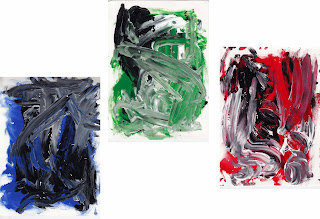
From here I went on to create my own experiments of expressionism painting, separating my emotions into Bleu, Green and Red. I selected a few songs from each album, I listened them to try and influence the final outcome giving each album it's own individual input. After producing a few pieces of expressionism for each colour I chose the versions that held the most texture because they held the most interesting areas to work with.


Again still carrying these ideas of colours and emotions, and that these are a form of emotional release that almost anyone can relate to sent my direction towards the ideas of this release being primal fundamental one of humankind. So I started to back track and came across a couple of symbols that really stood out to me. The first is of a simple spiral. It’s the oldest symbol known to man: not only representative of life and energy radiating but they also stood out to me conveniently enough as a record in itself.
There was another symbol that grabbed my attention, this being of three spirals linked together.This symbol although copied over generations as a Christian symbol of the holy trinity and other religious groups for its visual connotations, is essentially a prehistoric symbol thought to have represented the three stages of human life and growth within these, also the waxing and waning of the moon. And again well it also conveniently resembled what could be the three record joined as one. It was also a nice example of pulling together my three albums as one entity and representing different phases and stages of people and their emotions.


Pulling these concepts together I decided to use the triple spiral as the logo for that particular record release. I created a vector version of the symbol and applied different brush strokes until I found one with a texture I liked. I then copied and converted this into the three colours I had chosen.

To produce the sleeve covers I applied cropped and altered versions of my abstract paintings. Inspired by human emotion and the colours themselves I named each album accordingly as the blue “Deep”, the green as “Centred” and the red a “Passion”. Although a little pretentious sounding I thought they summed up what I was trying to convey and also ran nicely as a sentence as opposed to individual titles. I also decided to place a version of the logo over the record sleeves. I though that it would give a continuity to have the albums connected together as one when of the cover also discretely representing the differences in people coming from and back (and their emotions) to the same point visually tying the ideas together.


Using the record covers as the basis of design I created a cover for the compilation. I left the outer face white and applied the colour version of my logo that I think would have been effective in standing out from other surrounding designs. The inside I decide to reflect visually the piecing together of all three albums but if nothing else would still be aesthetically pleasing.

Lastly I tackled the posters. These were simple transitions as I used the design and typography as the basis and really felt the need to change the colour for each version. This was through the image and text but also by bringing the relevant colour within the logo forward making that tone more dominant.

I was quite happy with the outcome in the most part but one area I would definitely go back to focus on would be some of the fonts used. I think the overall design but mostly the record sleeves could have beneficial from further development possibly turning the font pt down and using clear serif font that would have given them much more professional appearance

Bibliography -

Books –

Jackson Pollock: Energy made visible, B. H. Friedman, Aug 1995.

Mark Rothko, Majorie B. Cohn, Feb 2001, Hatje Cantz Publishers.

Websites –

www.theartcyclopedia.com/artist/rothko_mark.html

www.jacksonpollock.com

www.whatsyoursign.com/celtic-symbol-meaning.html

www.whatsyoursign.co,/spiral-meaning.html

www.roughtraderecords.com/history

www.thinkexist.com

Semiotics/The Feelgood Co. Logo

This is the logo for ‘the feelgood drinks co. They’re an organic drinks company and boast about their ingredients’ having no added sugar and being one of your five a day. Below is a breakdown of the different elements that make up this logo and their connotations.


Colour - In this example the signifier is the colour green, but is always an organic colour/shade across their product line. This isn’t only a direct connection to the flavour of the drink but also acts as the signified with its connotations of being fresh and organic. Another signifier that reinforces that idea/or ‘sign’ of the product being organic is the grainy texture you can see within the colour.

Shape - Now here the overall shape being the signifier I can see how it splits into two clear ideas to be signified. The first being that of a slice of fruit the outer ring acting as the skin, although not all fruit used would be this shape it is still an obvious connection. The connotations that come through are that of our own planet. This brings the sign of being organic like the other signs so far but also on some level of ethical conscience you would expect the company to hold.

Text - The first impressions of this soft and organic typeface stets a relaxed tone. Here if you look at the way the font is placed around the logo, this seems to possibly signify a sunrise, and this along with one of the most obvious signifier of the small touch in the ‘g’ give signs of well being and wholesomeness. I think the lettering at the top of the logo is a nice extra touch as well as it sits on the top as though on top of the world just adding to that feel good factor and sense of well-being.

Image - The image in the centre holds the most obvious connotations of wellbeing as we immediately associate this position with meditation and self-awareness. The added little signifiers of jazz hands over the figures knees ads a fun element to an otherwise serious or self important exercise, this would signify the company taking a more joyful and light hearted approach to the ideas of well-being.

Overall “the feelgood co” have pulled many different element together to fill your conscious as well as subconscious with a number of light hearted and organic connotations. These work together to form a visually busy but very effective sign as their logo.

28 October 2009

April Greiman And Post-modernism Essay

Looking at April Greiman’s work it is easy to spot her as a contemporary designer. Greiman was instrumental in bringing in the style “New Wave” to the States. This style was a rebellious approach to compositions and type forms. Disregarding the practiced disciplines “New Wave” experimented with spacing, type weight, and angular type changing the way we viewed not only the words we read but how we read them and viewed the space they sit in. Throughout her work Greiman has pushed the boundaries of how we view type and composition, but the Swiss influences are often evident. Armin Hofmann, a tutor of Greiman was also one of the leading figures to develop the “Swiss Style” in the 1950’s. This was a style of typography that focused on cleanliness, legibility and objectivity. This was a great influence on Greiman, this method of viewing type and it’s space was the starting point Greiman used to move further, stretching the boundaries of view points to the point that it would become “New Wave” as we know it today. In the mid 80’s Greiman was able to take these ideals further with the introduction of the Macintosh (Mac) computer to design world. She was one of the first to embrace the new design tool leading the way for many more designers and acting as an icon for female designers across the globe.


The 1970’s saw Greiman graduate from the Kansas City Arts Institute before studying in Switzerland at the Allgemeine Kunstgewerbeschule in Basel. By 1975 she was working with Emilio Ambasz in New York’s Museum of Modern Art, before swiftly trading coast to open up her own graphic design studio “Made In Space, Inc.” by the end of ’76. Through out this time heavy oppressions seemed to lie over America. The Vietnam War was only just coming to an end and as it did Nixon’s “Watergate Scandal “ was just beginning to surface, the people were starting to feel disillusioned by their government and its propaganda. Work forces began to revolt and the 70’s saw many strikes across a variety of businesses. The people of America were fed up with the conditions they had been told to live with and decided to make a stand. In a graphic sense Greiman could be said to have made this stand in her own way through contemporary, fresh and rebellious type forms that threw away old methods and made a stand on open mindedness and new ways of thinking.

The anger of the 70’s ebbed into the consumerist 80’s and brought with it a return to economic growth. The “War on Drugs” had accelerated and the general attitude of society was changing. People had more of an inward attitude based on materialistic goods and self-image. These persuasions were helped by the advertising industry utilizing TV and movie stats of the time to advertise “must have” products in a way not seen since the 20’s, selling happiness at a price. I don’t see Greiman’s work as a reflection on this aspect of her surrounding culture at that time, but rather focuses more on the concepts behind the individual piece while reflecting the excitement surrounding the new digital media available to the design industry. It wasn’t until the 80’s that we really started to see women becoming more accepted and present within the work place. Concepts such as addressing women as Ms instead of Miss or Mrs were brought forward in the search for gender equality and as a stand against conventional views attached to the status of their title. This attitude towards gender (also referred to as post-modern feminism) is a strong example of post-modern ideals pushing through, as women were once again making a stand against the traditions of society in order to gain equality and their own individual identity. Greiman could be considered an icon in this respect especially to the women of this time; boldly tackling the challenges of the existing industry while embracing the new often quicker and more openly than most around her, producing prolifically and building up her own studio from the ground she never let society or situation oppress her and has followed her ideas and intuition throughout her working life, becoming a pioneer in her field.


From the commission of the 1984 Olympic Games poster in 1981 through to the work she produced for the Walter Art Center travelling exhibition 1989 Greiman had produced many ground breaking contemporary pieces not least of which was inspired by the arrival of the Mac. Greiman had been experimenting with ways of producing her work years before the mac’s arrival. Even from the beginning she was a pioneer in influencing people to experiment with their equipment and by trying to utilize the latest technology as her latest design tool. These examples were created by a couple of years before we were gifted the mac. They are experimental pages created using an analog computer, synthesizers, and live video input. Today these images could be easily reproduced on a Macintosh but to see the amount of creativity and thought that went into producing these experiments is inspiring. April Greiman has studied and worked through the postmodernism age, and while gaining from the reproducibility of art work also seemed to work under the postmodernism ideal of image consumerism and as explained (Appignanesi : 1995 p 49) reproducing products that would replace a space of reality with a hyper reality


When you look at an early piece of Greiman’s work (pre Mac) you immediately notice her familiar bold style. As well as using a variety of tools to create her work you will also see a midst the seemingly chaotic layout, a mix of style within her work. A mix of Art Deco and Art&Craft or Ornamental Pattern making come to mind. Bringing different styles of design together this way is otherwise known as “Radical Eclecticism”, a common theme in a lot of post-modern design. In other similar works Greiman often included photography (provided by associate Jayme Odgers). Situated within her work it added a sense of surrealism and another element to her style of “Radical Eclecticism”. As you can see in her work for wet magazine (1979), Greiman was already comfortable with pushing the boundaries of design. Throughout her work she has always challenged aspects such as space and linearity, and seems to have always held this post-modern view of their being no true structure to design and that there is no set path; the way forward is experimentation


(Post Mac) Looking at the poster “does it make sense?” 1986 you can see it as another example of “Radical Eclecticism” from April Greiman. The mixes in style in this piece stretch from Neolithic style illustrations to contemporary photography, digital manipulation and crossing fields’ incorporates scientific diagrams within the composition. I like this piece, as it’s a collection of elements relating to man, from the beginning of our time to present. Segments and ideas are pulled apart and pieced back together in an abstract way (a process and technique Greiman often used in a lot of her work), and then we’re asked, “does it make sense?”. Although she had used pixilation in her design long before the Mac came along the new technology definitely helped make this process easier to produce. It is in works such as this one that you can appreciate the economical value of the Macintosh as a design tool. There was fewer amounts of paper and waste at the end of experimentation processes as the design world were working towards manipulating light instead of matter. “Globally, Culturally and economically we are all moving from working with matter to working with light. With the Macintosh we’re manipulating light” (Farrelly : 1998 p8). This comment paints Greiman as an “Economical Post-modernist” of her decade, focusing on not only how or what she is producing but also how it would affect the world and the people around her. This is not the attitude of society that jumps to mind when I think of the 80’s, it stands as an example of Greiman’s open mindedness and spirituality, something that is evident in her life as well as work. It was shortly after producing this piece that in 1987 Greiman rightly won the National Endowment for the Arts grant for computer graphic studies and within the same year was also awarded a Hallmark Fellowship.

April Greiman, Design Quarterly N.o.133, Poster, 1986


By the beginning of the 90’s Greiman was working with “Sci-Arc” a Californian Institute of Architecture established around the 1970’s. Up until meeting Greiman the institute had not discovered their own graphic identity. This was a major commitment on Greiman’s part; she adopted the position and with her own style created their fixed identity as you see it today. The logo itself pulls at a post-modern attitude towards form. The name stretched and twisted, not only does away the with conventional ideas held around type but also, as it appears as a 3D object we are reminded of a flat piece of wood or metal that has been twisted before being captured for the image. This gave it another quality with its concept as the institute it was designed for study and develops the manipulation of such materials. Greiman to this day is a prolific designer, always looking for the new and unexplored regions of design and it’s processes and still displaying that Greiman energy and post-modern spirit within her work.


Book Refrance:

“No More Rules. Graphic Design And Post-moderism”

Rick Prynor

2003/Yale University Press

*********

“Introducing Postmoderism”

Richard Appignanesi

1995/Tien Wah Press

********

“April Greiman. Floating Ideas Through Time And Space”

Liz Farrelly

1998/Thames and Hudson Ltd. London

***


Website Referance:

http://www.aiga.org/content.cfm/medalist-aprilgreiman

http://www.madeinspace.la/home/home.html

http://www.britannica.com/EBchecked/topic/1080159/April-Greiman

http://www.artandculture.com/users/36-april-greiman